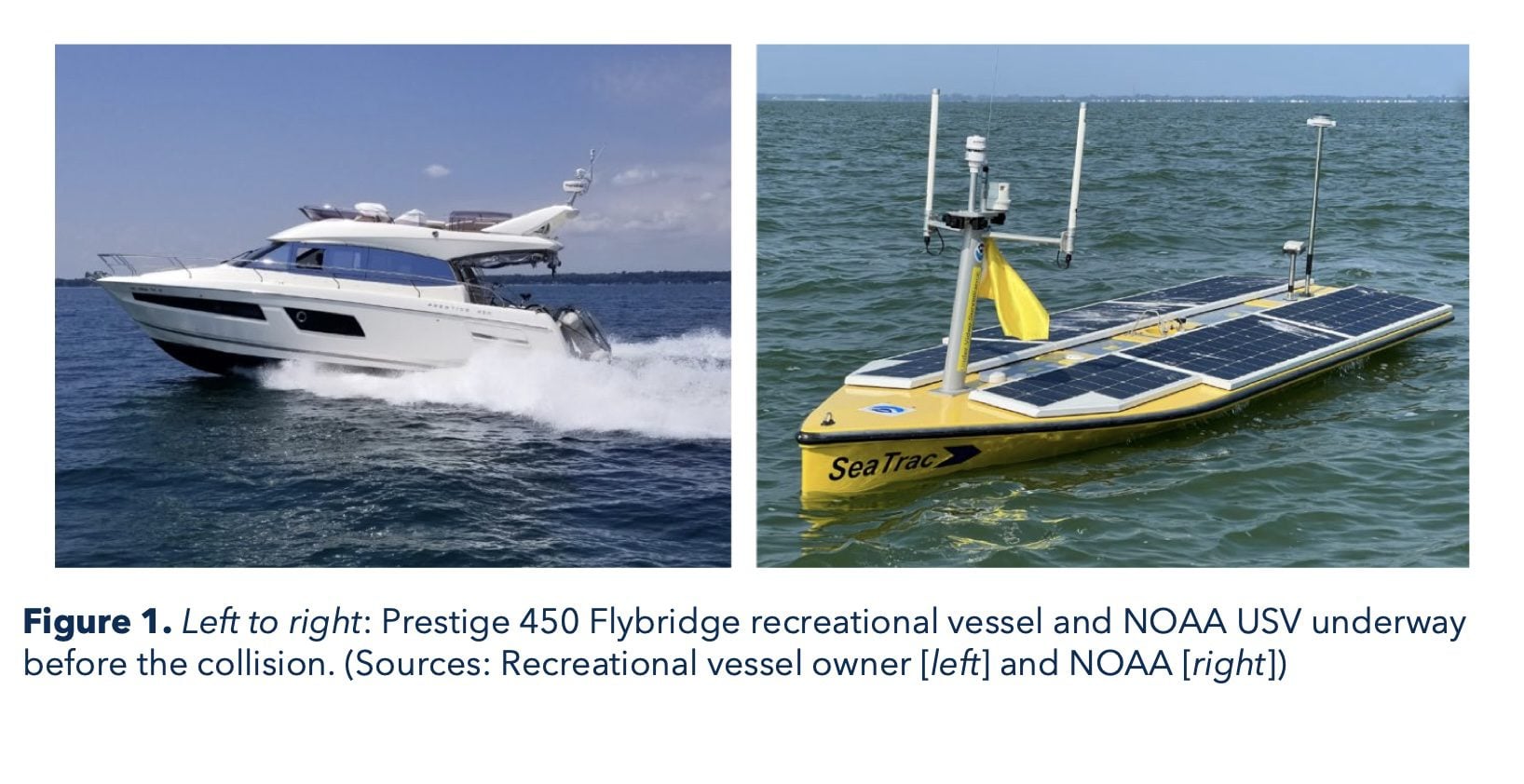
The US National Transportation Safety Board (NTSB) has urged the Coast Guard to introduce national safety standards for uncrewed surface vessels following a collision on Lake Erie, gCaptain reported. Its investigation found that a remotely monitored research craft was difficult for other waterway users to detect and could not independently take action to avoid a collision.
The accident occurred on 10 August 2024, about six miles east-southeast of Monroe, Michigan. A 15.7-foot SeaTrac SP-48 operated by the National Oceanic and Atmospheric Administration (NOAA) became caught in the starboard propeller pod of a privately owned, 45-foot Prestige 450 Flybridge recreational boat. The vessels were towed to a marina for separation. One person sustained a minor injury. The NOAA craft, valued at approximately $186,000, was deemed a constructive total loss, while damage to the recreational boat was estimated at $100,000.
According to gCaptain’s account of the findings, only about one foot of the research vessel’s hull stood above the water. Investigators judged it unlikely to be detected by the radar or automatic identification systems commonly used on local recreational boats. It also had no audible warning system to alert approaching traffic, compounding the difficulties other mariners faced in spotting it.
NOAA’s Great Lakes Environmental Research Laboratory was using an automated station-keeping setting called “adapted hold”. This returned the craft to designated waypoints when it moved beyond a 150-foot radius. A shore-based pilot monitored operations, but investigators found that oversight too passive for the conditions. With no ability to assess surrounding traffic and make collision-avoidance decisions itself, the vessel effectively lacked an adequate lookout.
The NTSB issued six safety recommendations in findings released Tuesday. It called for a national framework covering detectability, collision avoidance and navigational safety, incorporated into federal regulations. Investigators found no industry-wide standards specifically covering those areas for uncrewed surface vessels in US inland and territorial waters at the time of the accident.
Three recommendations directed at NOAA sought operating changes, including detectability testing against expected traffic and monitoring suited to each craft’s autonomy, environment and operating mode. Manufacturer SeaTrac Systems Inc. was also urged to improve the SP-48’s visibility and detectability. The recommendations do not themselves create new legal requirements.