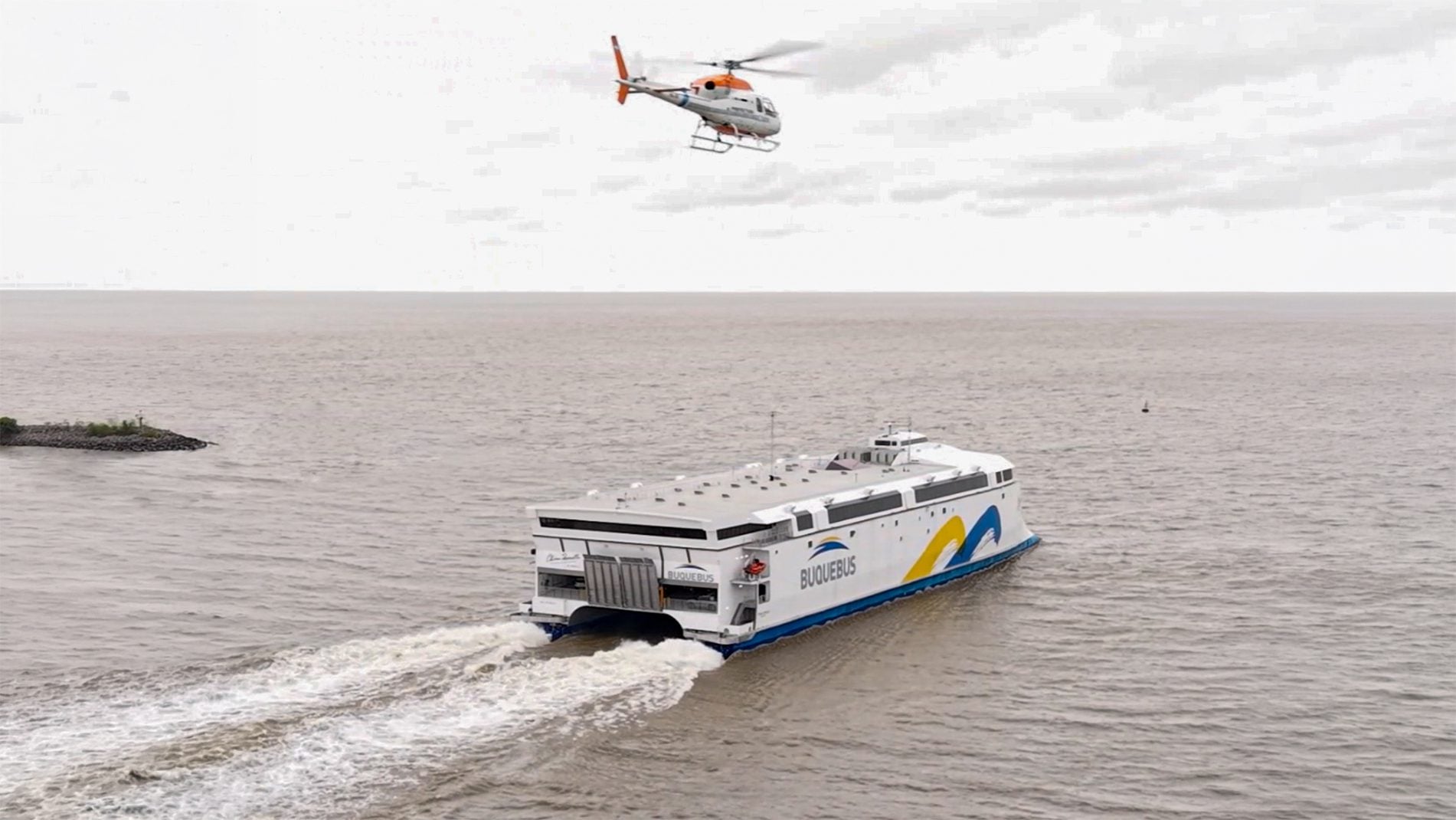
China Zorrilla, described by gCaptain as the world’s largest battery-electric ship, began commercial operations between Buenos Aires in Argentina and Colonia in Uruguay on 22 October. Built by Australian shipbuilder Incat Tasmania for ferry operator Buquebus, the 130-metre high-speed catamaran crosses the River Plate entirely on battery power, with capacity for up to 2,100 passengers and 225 vehicles.
The ferry’s propulsion system uses more than 250 tonnes of batteries, providing energy storage capacity exceeding 40 megawatt-hours, according to gCaptain. These supply eight electrically powered waterjets rather than conventional marine engines. Dedicated high-power charging facilities at the terminals on both banks allow the vessel to recharge between crossings, supporting its operation on the fixed international route.
The move into service follows a substantial change to the vessel’s original propulsion plans. China Zorrilla was initially designed with dual-fuel engines able to burn diesel and liquefied natural gas, but was subsequently reworked for battery-only operation. That decision required major engineering changes during construction. The completed ferry produces no direct exhaust emissions while making its crossings and has less machinery noise and vibration than a vessel using conventional diesel engines, the report said.
An official ceremony took place in Buenos Aires on 21 October, ahead of the first commercial voyage. Attendees included Incat managing director Craig Clifford, representatives of Buquebus, and maritime authorities and government officials from Argentina and Uruguay. Incat chairman Robert Clifford credited hundreds of employees at the company’s Hobart shipyard with resolving the engineering difficulties involved, describing the project as a demonstration that large commercial vessels can use electric propulsion.
Craig Clifford, who travelled on the maiden commercial crossing, highlighted the reduced engine noise and vibration experienced by passengers. The ferry also has around 2,300 square metres of duty-free shopping space. Its delivery comes as Incat expands its electric vessel construction programme: gCaptain reported that the Hobart yard is building three 129-metre battery-electric ferries for Danish operator Molslinjen, alongside two 78-metre hybrid-electric vessels.